How to Choose the Right Bariatric Mattress for Home Hospital Beds
Selecting a bariatric mattress for home care? Learn about weight ratings, pressure redistribution, and which mattress types work best for larger patients.
Sarah Nguyen
Patient Care Coordinator
Choosing the right mattress for a bariatric hospital bed is often the single most critical factor in a patient’s recovery plan. We have seen too many families focus entirely on the bed frame while treating the mattress as an afterthought.
That oversight creates immediate risks.
A standard home hospital bed mattress is simply not engineered for patients over 350 pounds. The foam will compress too rapidly. This lack of support leads to “bottoming out,” where the patient rests against the metal deck.
Pressure injuries can form in as little as two hours under these conditions.
We wrote this guide to help you prevent that outcome.
Here is the data and criteria you need to choose the right bariatric mattress for home care.
Why Bariatric Patients Need a Specialized Mattress
Standard foam collapses under heavy weight, but bariatric mattresses are engineered to fight gravity.
We define “bottoming out” as the failure of a support surface to redistribute weight effectively. When this happens, capillary closure pressure often exceeds 32 mmHg.
Blood flow to the skin stops at that threshold.
Tissue death begins shortly after.
A true bariatric mattress solves this through high-resiliency (HR) foam or active air cells. These materials provide “immersion” and “envelopment.” Immersion allows the body to sink just enough to spread weight over a larger surface area. Envelopment contours the mattress to the body’s shape.
This combination reduces the pressure on bony prominences like heels and hips.
Types of Bariatric Mattresses
We categorize these mattresses into three distinct classes based on the patient’s mobility and skin health risk.
1. High-Density Foam Bariatric Mattress
Best for: Patients who can shift their own weight or have low risk of skin breakdown.
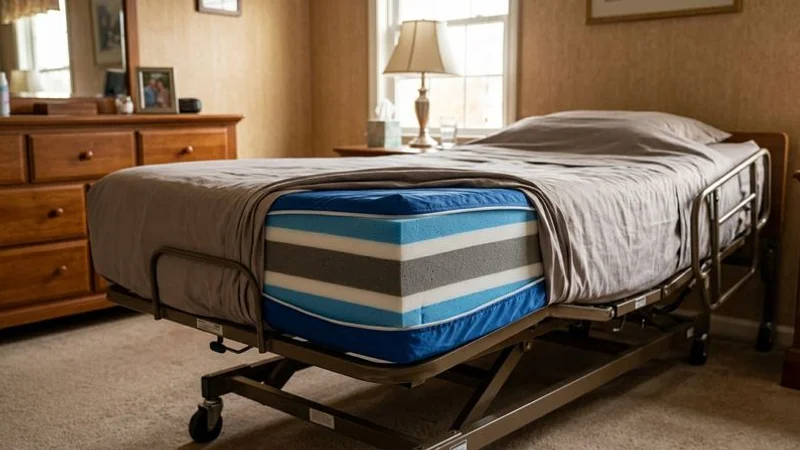
High-density foam is the industry standard for reliable support. We look for multi-layered construction in these models. A firm base layer prevents bottoming out, while a softer top layer cradles the body.
The density here is the key differentiator.
Standard hospital mattresses often use foam rated at 1.2 to 1.5 lb/ft³. A quality bariatric mattress uses foam rated at 2.0 lb/ft³ or higher.
| Feature | Performance Standard |
|---|---|
| Typical Thickness | 7-9 inches |
| Weight Capacity | 600-1,000 lbs |
| Pressure Redistribution | Static (Passive) |
| Average Lifespan | 1-3 years |
| Cost Tier | $$ (Moderate) |
Pros:
- Provides a stable surface for transfers.
- Zero noise (no pumps or motors).
- Requires minimal maintenance beyond cleaning.
Cons:
- Retains body heat more than air systems.
- Offers limited protection for existing wounds.
2. Bariatric Alternating Pressure Mattress
Best for: Patients who are immobile or currently treating pressure injuries.
This technology actively changes the pressure points on the body. An external pump inflates and deflates specific air cells in a cycle, usually every 10 to 15 minutes.
We often recommend this for “Group 2” support surface candidates under Medicare guidelines.
It mimics the physiological benefits of a patient shifting their weight in bed. This constant movement ensures that no single area of skin is under pressure for a dangerous amount of time.
| Feature | Performance Standard |
|---|---|
| Typical Thickness | 8-10 inches |
| Weight Capacity | 600-1,000 lbs |
| Pressure Redistribution | Active (Dynamic) |
| Average Lifespan | 3-5 years (Pump dependent) |
| Cost Tier | $$$$ (Higher) |
Pros:
- Superior prevention and treatment of Stage I-IV pressure injuries.
- “Low Air Loss” features often help manage skin moisture (microclimate).
- Firmness is adjustable via the digital pump.
Cons:
- Requires electricity 24/7 to operate.
- The pump produces a low hum (typically under 30 dB).
- The surface creates a floating sensation that can make transfers difficult.
For a deeper dive into how alternating pressure systems work, see our alternating pressure mattress guide.
3. Bariatric Gel-Foam Hybrid Mattress
Best for: Patients who sleep hot or need moderate pressure redistribution.
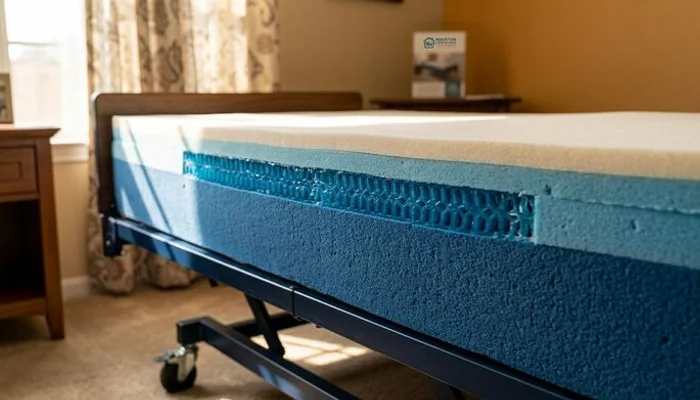
Gel-foam hybrids occupy the middle ground between static foam and active air. Manufacturers infuse the top layer of visco-elastic foam with cooling gel beads.
We find this effectively combats the “heat trap” common with standard foam.
The gel material has a high thermal conductivity. It pulls heat away from the patient’s body and dissipates it into the surrounding foam.
| Feature | Performance Standard |
|---|---|
| Typical Thickness | 7-10 inches |
| Weight Capacity | 600-750 lbs |
| Pressure Redistribution | Moderate (Passive+) |
| Average Lifespan | 2-4 years |
| Cost Tier | $$$ (Moderate-High) |
Pros:
- Excellent temperature regulation for patient comfort.
- Better contouring than standard high-density foam.
- No noise or power source required.
Cons:
- Significantly heavier to move than standard foam.
- Gel can degrade faster than high-density base foam over time.
How to Choose: Decision Framework
We use the “Braden Scale” logic to guide these decisions. This medical tool assesses risk based on sensory perception, moisture, activity, mobility, nutrition, and friction.
You can use a simplified version of that framework to make your choice.
Step 1: Determine the patient’s mobility level
- Can reposition independently: High-density foam is sufficient.
- Needs assistance to move: Gel-foam or alternating pressure is safer.
- Cannot move at all: Alternating pressure is a medical necessity.
Step 2: Assess pressure injury risk
- Low Risk (Healthy skin, mobile): High-density foam.
- Moderate Risk (Fragile skin, limited mobility): Gel-foam hybrid.
- High Risk (Existing bedsores, diabetes, immobility): Alternating pressure with Low Air Loss.
Step 3: Factor in “Shear” and “Friction”
- Frequent sliding down in bed: Look for a mattress with a dedicated “shear reduction” cover. These covers stretch in four directions to move with the patient’s skin rather than rubbing against it.
Step 4: Verify the Weight Capacity Buffer
- The Safety Rule: Always select a mattress rated for at least 100 pounds more than the patient’s current weight. A 350 lb patient on a 350 lb rated mattress will degrade the foam within months.
Critical Mattress Specifications
Marketing terms can be vague, so we look at the engineering specs.
Pay attention to these specific numbers when comparing models.
Foam Density (lb/ft³): This indicates durability, not firmness. Standard foam is 1.5 lb/ft³. You want a bariatric mattress with a support layer of at least 2.0 to 2.5 lb/ft³. This ensures the mattress won’t sag after a few months of use.
ILD (Indentation Load Deflection): This measures firmness. A standard mattress has an ILD of 25-30. Bariatric patients require an ILD of 40-50 in the base layer to provide adequate pushback against heavier weight.
Vapor Permeability (MVTR): This measures breathability. The cover must be waterproof but vapor-permeable. Look for a Moisture Vapor Transmission Rate (MVTR) that allows humidity to escape. This prevents skin maceration, which is softening of the skin due to sweat.
Fire Safety: Federal law requires compliance with 16 CFR Part 1633. This is the flammability standard for mattress sets. All medical-grade mattresses must meet this strict open-flame test.
Mattress Size Guide
We frequently see families order a mattress that fits the bed frame but not the room.
Please measure your doorways before ordering a 54-inch wide bed.
| Bed Type | Mattress Width | Recommended Door Width |
|---|---|---|
| Heavy-Duty (42”) | 42 inches | 36+ inches (Standard Entry) |
| Bariatric (48”) | 48 inches | 40+ inches (Wide Entry) |
| Super Bariatric (54”) | 54 inches | Double Doors or Assembly in Room |
Insider Tip: The mattress width must match your bariatric bed frame exactly. A 42-inch mattress on a 48-inch frame creates a 3-inch gap on each side.
That gap is an entrapment hazard.
Patient limbs can get stuck between the mattress and the rails.
Maintenance Tips
Bariatric equipment endures significant stress. Proper maintenance protects your investment and the patient’s health.
Rotate the mattress monthly. Foam memory is real. Flipping the mattress from head to foot (if the design allows) prevents permanent impressions where the patient’s hips rest.
Inspect the cover for “strikethrough.” This is industry jargon for fluid penetrating the cover. Unzip the cover monthly and check the foam surface. If you see stains on the foam, the cover has failed and the mattress is contaminated.
Clean with the right dilution. Harsh chemicals destroy waterproof coatings. We recommend using a quaternary ammonium solution or a 1:10 bleach-to-water ratio. Always rinse with clean water and dry thoroughly.
Avoid consumer fitted sheets. Standard deep-pocket sheets often pop off bariatric corners. Use hospital-grade sheets designed for high-depth medical mattresses. They distribute tension evenly and reduce skin shearing.
We Include the Right Mattress with Every Rental
When you rent a bariatric bed from Houston Hospital Beds For Home, we remove the guesswork.
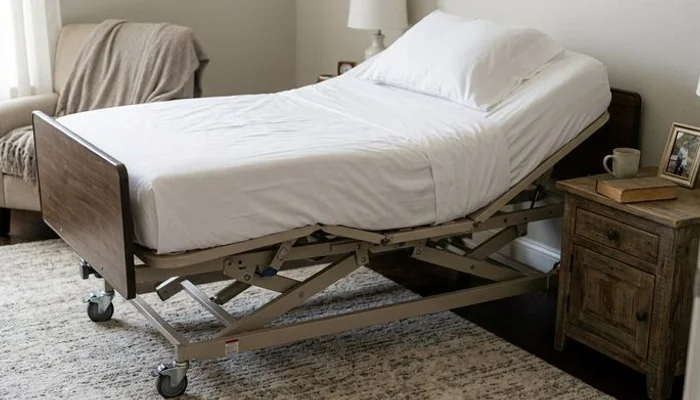
A weight-rated bariatric mattress is included in our standard package.
Our team reviews the patient’s weight, mobility status, and skin condition during the initial consultation. We then match those medical needs to the correct density and pressure profile.
You also have options for advanced care.
If the patient requires high-level protection, we can upgrade the rental to a digital alternating pressure system or a cooling gel-hybrid. You can compare the full range of specs on our mattresses and accessories page.
Contact us for a free quote or call (713) 555-0123. We are ready to help you secure the safest, most comfortable sleep solution for your home.
Need a Hospital Bed in Houston?
Get a free, no-obligation quote with transparent pricing and same-day delivery options.