Essential Hospital Bed Accessories Every Home Caregiver Should Have
From overbed tables to safety rails and trapeze bars, these hospital bed accessories make home caregiving safer and more comfortable for everyone.
Marcus Thompson
Founder & Medical Equipment Specialist
Based on our years of experience setting up hospital beds for home care environments in the US, we know that a hospital bed is just the foundation.
It is the surrounding equipment that truly dictates the quality of daily care.
Real efficiency happens when you add the right tools to the mix.
We see families rent a high-end bed but struggle because they lack the practical accessories that make caregiving sustainable.
The right setup transforms a bedroom into a safe, functional clinic.
Here are the Essential Hospital Bed Accessories Every Home Caregiver Should Have.
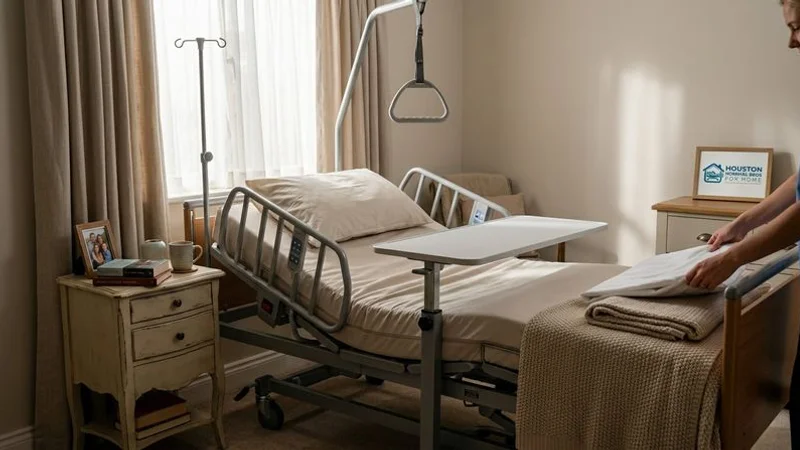
1. Overbed Table
An overbed table is a wheeled, height-adjustable surface that slides over the bed.
This simple accessory often becomes the center of the patient’s world.
We find that most families underestimate how much this table gets used until they have one.
Why the base shape matters: Most durable medical equipment (DME) tables, like those from Drive Medical or Invacare, come with either a “C” base or an “H” base.
- C-Base (or U-Base): This open design slides easily around wheelchair wheels or under a bed with low clearance.
- H-Base: This offers more stability but can be harder to maneuver around chairs.
Critical weight limit warning: Standard overbed tables typically support only 25 to 50 pounds. Never lean your full body weight on them or use them to pull yourself up. Doing so can cause the table to snap or tip over instantly.
What patients use it for:
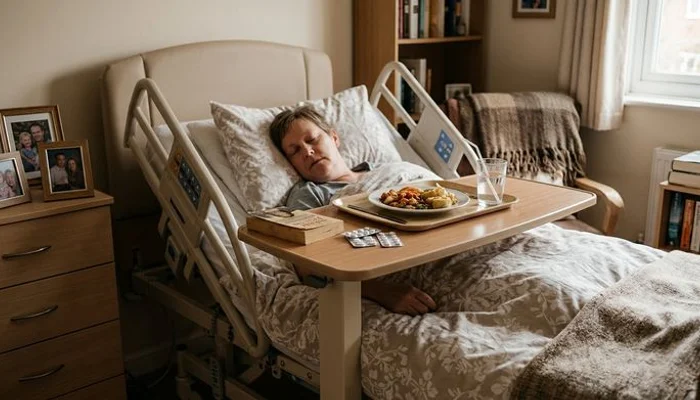
- Eating meals without leaving bed
- Taking medications with a glass of water
- Reading, puzzles, or using a tablet
- Holding personal items like phones and tissues
- Writing or signing documents
What caregivers use it for:
- Organizing supplies for wound care
- Holding wash basins for in-bed bathing
- Staging clean clothing for dressing changes
Features to look for:
- Tilt-adjustable top: Essential for reading or tablet use to prevent neck strain.
- Auto-touch height adjustment: Look for a spring-loaded mechanism that raises with a light touch rather than a crank.
- Laminate surface: Ensure it is non-porous for easy sanitation with wipes.
An overbed table is the accessory patients use the most.
If you only add one thing beyond the basic bed setup, make it this.
2. Half-Length Side Rails
Most hospital beds offer a choice between full-length and half-length rails.
We almost exclusively recommend half-length rails for home care.
Full-length rails can often create a feeling of imprisonment and actually increase the risk of injury if a patient tries to climb over them.
The “Zone of Entrapment” safety rule: The FDA has identified specific “zones” where patients can get stuck between the mattress and the rail. We ensure all our installations meet the gap standard of less than 4.75 inches to prevent entrapment. Always check that your mattress fits the bed frame snugly to maintain this safety gap.
Half-length side rails:
- Extend from the head to about hip level
- Provide a solid handhold for independent repositioning
- Prevent accidental rolling during sleep
- Allow the patient to exit at the foot end freely
- Lower entrapment risk significantly compared to full rails
When full-length rails are appropriate:
- Patient has severe cognitive impairment or dementia
- Patient is at very high fall risk and lacks the mobility to exit safely
- Physician specifically orders full containment
Important safety note: Side rails should never be used as restraints.
If a patient consistently tries to climb over the rails, the rails are not the solution.
Consult with their healthcare provider about safer alternatives immediately.
Learn more about rail selection in our guide to the best hospital bed features for elderly patients.
3. Trapeze Bar
A trapeze bar is a triangular handle suspended from a frame above the bed.
This tool is a game-changer for preserving a caregiver’s back health.
We see a massive reduction in caregiver strain when a patient can self-assist using a trapeze.
Mounting options and weight limits:
- Bed-Mounted: Attaches directly to the bed frame. These typically have a weight limit of 250 lbs.
- Free-Standing (Floor Stand): sits on the floor around the headboard. These are heavy-duty options often rated for 450 to 650 lbs (bariatric use).
The patient uses it to:
- Pull up to a sit: This engages the biceps and lats rather than the core.
- Reposition: They can lift their hips to help you slide a draw sheet or change a pad.
- Transfer: It acts as a pivot point for swinging legs over the side.
Best for: Patients recovering from hip or knee surgery, paraplegia, and anyone with strong arms but limited leg strength.
Not recommended for: Patients with shoulder injuries, stroke victims with hemiplegia, or those with weak grip strength.
Pro Tip: Position the trapeze handle slightly toward the center of the bed, not directly over the head. This allows the patient to pull themselves forward naturally rather than pulling straight up, which is harder on the shoulders.
4. Bed Exit Alarm
A bed exit alarm is a safety device that alerts you the moment a patient attempts to leave the bed.
Falls are the leading cause of injury for older adults, resulting in 3 million ER visits annually according to the CDC.
We consider these alarms essential for patients with memory issues who forget they cannot walk safely.
Types available:
- Under-mattress pressure pad: This goes under the fitted sheet and detects when weight is removed. It is discreet and effective.
- Clip-on sensor: A string clips to the patient’s clothing. If they move too far, the magnet pulls free and sounds the alarm.
- Wireless systems: These send the alert to a pager in another room so the noise doesn’t startle the patient.
Dealing with “Alarm Fatigue”: Constant beeping can desensitize caregivers. We suggest using a system with a delay setting (1-2 seconds) to avoid false alarms when a patient just shifts position. Look for the “Smart Caregiver” brand or similar reliable monitors that offer variable volume controls.
These are not restraints; they are early warning systems.
For more safety strategies, read our fall prevention tips for elderly bedrooms.
5. IV Pole
Patients receiving home infusion therapy require a stable platform for fluids.
Attempting to hang bags from curtain rods or light fixtures is dangerous and unreliable.
We install IV poles directly onto the bed frame to ensure the lines move with the patient.
Critical feature check:
- Hook Count: Look for a “Ram’s Horn” (2-hook) or 4-hook top to manage multiple bags.
- Stability: If you choose a floor-standing model, ensure it has a 5-leg “spider base” (like the ones in hospitals) rather than a 4-leg base, which tips over easily.
When you need an IV pole:
- Home IV antibiotic therapy
- TPN (total parenteral nutrition)
- Tube feeding via gravity
- Home chemotherapy protocols
- IV pain management pumps
Most IV poles are clamp-mounted and adjustable in height.
Our delivery team installs them during bed setup if ordered.
6. Bed Wedge and Positioning Pillows
Electric beds handle the major movements, but foam wedges handle the micro-adjustments.
Proper positioning is the first line of defense against skin breakdown.
We strongly advise against using standard bed pillows for medical positioning as they are often too soft to maintain the angle.
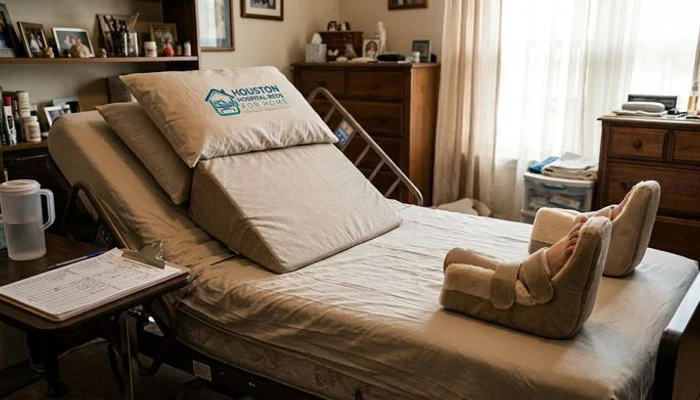
Bed wedge: A firm foam triangle used to support the back. For medical effectiveness, look for a wedge that provides a 30-degree tilt. This specific angle is proven to reduce pressure on the sacrum (tailbone) more effectively than a full 90-degree turn.
Heel elevation boots/pillows: These specialized supports lift the heels completely off the mattress “floating the heels.” The heel is one of the fastest places for a pressure ulcer to form. Standard pillows will compress over time, but high-density heel boots maintain the gap.
Abduction pillow: A foam block placed between the legs. Surgeons often require this after total hip replacement to prevent the hip from popping out of the socket (dislocation).
7. Mattress Upgrade
The standard rental mattress is usually a basic foam slab.
While sufficient for short-term recovery, it offers minimal protection against bedsores.
We assess the patient’s “Braden Scale” score (a measure of bedsore risk) to determine the right surface.
| Mattress Type | Risk Level Suitability | Added Cost | Key Feature |
|---|---|---|---|
| Gel-foam hybrid | Low to Moderate | $50-$100/mo | Gel disperses body heat to keep skin cool and dry. |
| Alternating pressure | High to Very High | $75-$150/mo | Air cells inflate/deflate automatically to shift weight. |
| Memory foam | Low Risk | $40-$75/mo | Contours to the body for comfort but retains heat. |
| Bariatric high-density | Patients 350+ lbs | Included with bariatric beds | Reinforced foam prevents “bottoming out” on the metal frame. |
For a complete guide to mattress selection, see how to choose the right hospital bed mattress.
8. Bed Sheets and Waterproof Protectors
Hospital bed mattresses have unique dimensions (usually 36” x 80” or 84”).
Standard Twin XL consumer sheets often pop off the corners when the head of the bed is raised.
We recommend using healthcare-specific textiles to protect the patient’s skin.
Why material matters:
- Knitted Sheets: Look for jersey knit (t-shirt material). These stretch when the mattress moves, preventing the “drum” effect where tight sheets create pressure on toes.
- Fitted sheets: Must have deep pockets designed for medical mattresses.
- Draw sheets: This creates a handle under the patient’s torso, allowing you to slide them up the bed without grabbing their skin.
- Waterproof mattress protectors: Essential for hygiene and protecting the rental asset.
Using consumer sheets on a hospital bed leads to bunching and wrinkles.
Those wrinkles become hard ridges that can damage fragile skin in a matter of hours.
How to Bundle Accessories
Most families benefit from a comprehensive setup rather than piecing it together.
We have curated these bundles based on the most common care scenarios we encounter in Houston.
Basic Bundle:
- Overbed table
- Half-length side rails
Safety Bundle:
- Basic Bundle items
- Bed exit alarm
- Low-height positioning settings
Comfort Bundle:
- Basic Bundle items
- Mattress upgrade (Gel or Air)
- Positioning pillows
Complete Bundle:
- All of the above items
- Ideal for comprehensive long-term care or hospice situations
Bundling accessories with your bed rental typically saves money compared to renting each piece separately.
Ask us about package pricing when you request your free quote.
We Deliver and Set Up Everything
Navigating medical equipment options can be overwhelming.
We handle the heavy lifting so you can focus on your loved one.
Our technicians deliver, install, and demonstrate every piece of equipment during the initial visit.
You do not need to figure out assembly or installation on your own.
Browse our full range of mattresses and accessories or call (713) 555-0123 to discuss what your loved one needs.
We deliver across Greater Houston, often the same day.
Need a Hospital Bed in Houston?
Get a free, no-obligation quote with transparent pricing and same-day delivery options.