Why Hospital Bed Height Adjustment Matters for Caregivers
Learn how electric bed height adjustment reduces back strain, makes transfers safer, and improves daily caregiving tasks at home.
Sarah Nguyen
Patient Care Coordinator

If there is one hospital bed for home care feature our team wishes every caregiver knew about, it is electric height adjustment. We see many families focus on head elevation or foot positioning, but the ability to raise and lower the entire bed frame with the push of a button is the true game-changer for long-term care.
This single feature prevents more caregiver injuries and makes daily tasks easier than any other bed function. We want to explain exactly why this matters so much for your health and your loved one’s safety.
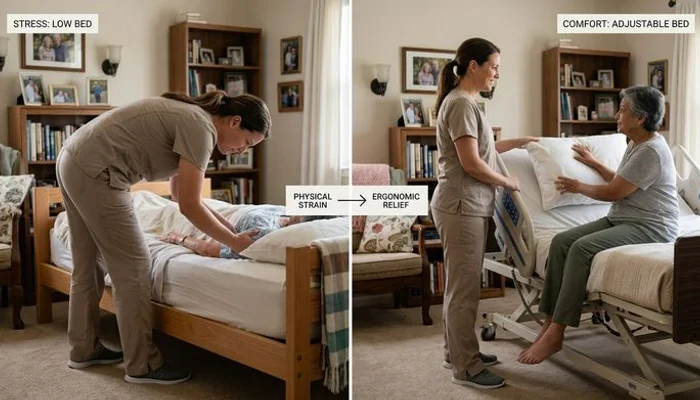
The Problem: Caregiving at the Wrong Height
Most regular beds sit at a fixed height of about 20 to 25 inches. This static position creates a daily physical crisis for caregivers who need to perform complex medical tasks.
- Bed linen changes become hazardous. Bending over a low bed forces you to lift the mattress weight with your spine curved, which significantly increases pressure on your lower back discs.
- Dressing assistance causes strain. Reaching down to help with socks or pants requires awkward twisting that fatigues the shoulder and lumbar muscles.
- Wound care lacks precision. Working at an uncomfortable angle reduces your stability and visibility when cleaning delicate areas or applying dressings.
- Transfers carry high injury risks. A bed height that does not match the wheelchair or commode forces you to lift the patient’s body weight against gravity.
- Repositioning requires excessive force. Pulling a patient up in bed while bending over puts you at a mechanical disadvantage that often leads to injury.
The statistics on this are alarming. According to recent data, over 52% of professional caregivers report chronic back pain, and the National Institute for Occupational Safety and Health (NIOSH) recommends a lifting limit of just 35 pounds when conditions are not ideal. Our experience confirms that by the time many families contact us, the primary caregiver is already suffering from a preventable injury.
How Electric Height Adjustment Solves This
A full-electric hospital bed allows you to raise and lower the entire bed frame, typically ranging from a low of 9 inches to a high of 30 inches depending on the model. This adjustability changes the physics of caregiving instantly.
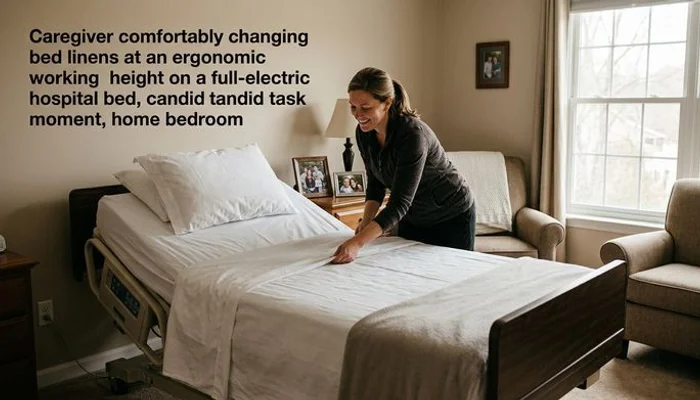
You can optimize for care tasks. Raise the deck to your waist or elbow height so you can work with a straight back.
We recommend matching transfer heights. Adjust the bed to be level with the wheelchair seat to allow for a lateral slide transfer that requires minimal lifting.
You can significantly reduce fall risks. Lower the bed to its minimum height at night so that if the patient rolls out, they are only inches from the floor. For more on this, see our fall prevention tips for elderly bedrooms.
We also prioritize patient independence. Set the bed height so the patient’s feet sit flat on the floor when they sit on the edge, which provides the leverage needed to stand up safely.
Daily Tasks That Benefit from Height Adjustment
Morning Routine
Raise the bed to help the patient sit up and then lower it to their specific transfer height. We look for the “90-90-90” rule where hips, knees, and ankles are all at 90-degree angles. This position makes standing up mechanically easier and reduces the amount of assistance you need to provide.
Bed Changes and Bathing
Raise the bed to your waist height before stripping the linens. This simple adjustment transforms a bed change from a back-breaking chore into a manageable task you can perform while standing upright. Our technicians often demonstrate how in-bed bathing becomes safer when you can reach all areas without overextending.
Wound Care and Medical Tasks
Precision is critical for wound cleaning, catheter care, and dressing changes. We advise raising the bed until the mattress is just below your elbow height. This allows you to use both hands effectively and maintain the steady control required for delicate medical procedures.
Transfers Throughout the Day
The average home care patient transfers between bed and wheelchair 4 to 8 times per day. We know that if the bed height does not match the wheelchair, every single transfer involves a dangerous lift or an uncontrolled drop. With electric height adjustment, you can align the surfaces perfectly in seconds.
Nighttime Safety
Lower the bed as part of your evening shut-down routine. We have seen that if a patient tries to get up at night or rolls out of bed, a low deck height drastically reduces the impact force. This small change is a powerful proactive safety measure.
The Cost of Not Having Height Adjustment
The price difference between a semi-electric bed (manual height crank) and a full-electric bed (electric height adjustment) is typically negligible compared to the medical costs of an injury. We generally see a rental difference of about $50 to $100 per month.
Compare that modest investment to the reality of a caregiver back injury:
- Medical treatment is expensive. Doctor visits, MRIs, and physical therapy often cost between $500 and $5,000 out of pocket.
- Lost income adds up. If the caregiver works outside the home, days off for recovery result in hundreds or thousands of dollars in lost wages.
- Replacement care is costly. Hiring a temporary agency caregiver typically costs $25 to $35 per hour.
- The emotional toll is heavy. When a primary caregiver is injured, the entire family faces increased stress and uncertainty.
The math is clear to us. We view the upgrade to full-electric not as a luxury expense but as a necessary form of insurance for the caregiver’s long-term health.
Semi-Electric vs Full-Electric: The Height Factor
A semi-electric bed uses a hand crank for height adjustment while the head and foot sections are electric. We find that while this option exists, it presents significant practical barriers:
- It is physically demanding. You must bend down and turn a crank 30 to 40 times to make a significant height change.
- We see compliance drop. Because it is slow and difficult, tired caregivers often skip the adjustment and work at the wrong height.
- It limits independence. A patient in bed cannot reach the crank at the foot of the bed to adjust their own height.
- We recommend full-electric for speed. A full-electric bed adjusts silently in 15 to 20 seconds with zero physical effort.
This convenience ensures that you will actually use the feature for every task. For a detailed comparison, read our guide on semi-electric vs full-electric hospital beds.
Practical Height Guidelines
We have compiled these recommended height settings based on ergonomic best practices and caregiver feedback.
| Task | Recommended Height Setting | Why It Matters |
|---|---|---|
| Sleeping | Lowest possible (8-10 inches) | Minimizes injury risk from accidental falls or roll-outs. |
| Sit-to-Stand | Patient’s knee height (~18-20 inches) | Allows feet to be flat on the floor for maximum leverage. |
| Wheelchair Transfer | Match wheelchair seat height | Creates a level slide that reduces lifting effort. |
| Linen Change | Caregiver’s hip bone height | Prevents stooping and protects the lower lumbar spine. |
| Wound Care | Caregiver’s elbow height | Maximizes visibility and hand stability for precision. |
| Dining | Comfortable upright position | Aligns with overbed tables for safe swallowing. |
Our Beds Include Full Training
When we deliver a full-electric bed to your Houston home, our technicians do more than just drop it off. We demonstrate every height setting and help you mark the correct levels on the wall or bed frame for your specific needs.
Our team also teaches the patient how to use the hand pendant to adjust their own height safely. This hands-on training is a standard part of our service because equipment is only useful if you know how to operate it confidently.
Protect Your Back and Your Loved One
If you are a home caregiver in the Houston area and you are dealing with back pain or unsafe transfers, the right hospital bed can change your daily experience dramatically. We are ready to help you select the model that best fits your specific care plan.
Contact us for a free quote or call (713) 555-0123 to speak with a specialist who understands your needs. We are committed to making your home care journey safer and more sustainable.
Need a Hospital Bed in Houston?
Get a free, no-obligation quote with transparent pricing and same-day delivery options.