How to Choose the Right Hospital Bed Mattress for Home Care
Foam, gel, innerspring, or alternating pressure? This guide explains hospital bed mattress types so you can pick the best one for your loved one's comfort.
Marcus Thompson
Founder & Medical Equipment Specialist
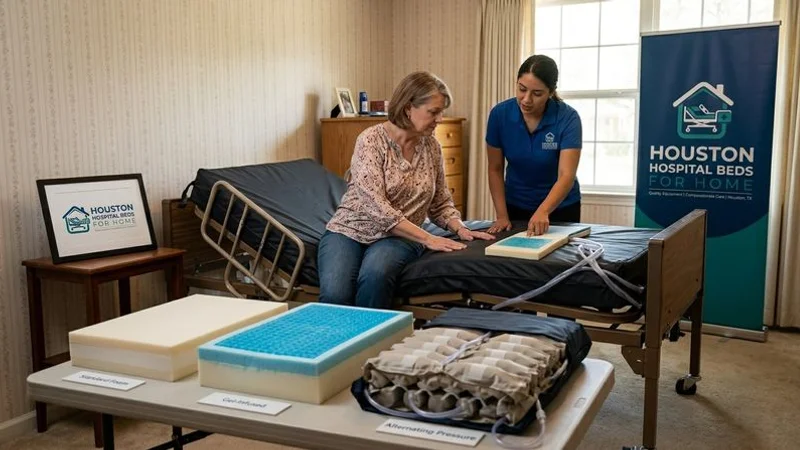
The mattress is just as important as the bed frame. In our experience, it might actually be the most critical component of the entire home hospital bed setup.
Your loved one will likely spend 12 to 20 hours a day on this surface. The right choice directly impacts their skin health, sleep quality, and overall pain levels.
We wrote this guide to simplify the technical details. You will find a straightforward breakdown of the main hospital bed mattress types below.
Why Hospital Bed Mattresses Are Different
Hospital bed mattresses are fundamentally different from the consumer mattress you might have in your master bedroom. They must meet specific medical and safety standards that standard retail models simply do not address.
We see families try to use regular twin mattresses on hospital frames, but this often leads to safety hazards.
Medical mattresses are engineered for patients who:
- Face shear and friction risks: Regular tossing and turning can damage fragile skin.
- Require hygiene control: Medical covers must resist fluids and bacteria.
- Need specific dimensions: Most hospital beds are 36 inches by 80 inches, which is different from a standard 38-inch by 75-inch Twin.
- Must meet fire codes: Federal regulation 16 CFR 1633 mandates strict flammability standards for these specific use cases.
- Utilize adjustable frames: The foam must flex repeatedly at the head and knee sections without cracking or bunching.
Consumer mattresses often lack the flexibility to bend with the frame. Using one can void the bed’s warranty or create dangerous gaps where a patient could get trapped.
Hospital Bed Mattress Types Compared
We compiled this data to help you compare the practical differences between the most common options.
| Type | Pressure Relief | Comfort | Maintenance | Cost | Best For |
|---|---|---|---|---|---|
| Standard foam | Basic | Good | None | $ | Short-term recovery |
| High-density foam | Good | Very good | Rotate monthly | $$ | Long-term, mobile patients |
| Gel-foam hybrid | Very good | Excellent | Rotate monthly | $$$ | Heat-sensitive patients |
| Memory foam | Good | Excellent | Rotate monthly | $$$ | Comfort-focused care |
| Innerspring | Basic | Good | None | $ | Budget-conscious, mobile patients |
| Alternating pressure | Excellent | Good | Check pump weekly | $$$$ | Immobile, high-risk patients |
Standard Foam Mattress
This is the baseline model included with most standard bed rentals. Manufacturers typically use a medium-density polyurethane foam, often rated around 1.2 to 1.5 pounds per cubic foot (lb/ft³).
We generally recommend this for patients who will not be confined to bed all day.
Pros:
- Cost-effective: It keeps upfront rental or purchase costs low.
- Zero maintenance: There are no pumps to check or complex cleaning routines.
- Lightweight: You can easily lift it to change linens.
Cons:
- Durability issues: Lower density foam softens quickly under constant weight.
- Heat retention: Basic polyurethane does not circulate air well.
- Limited support: It is not suitable for patients over 250 lbs.
Best for: Post-surgery recovery of 1-3 months or patients who can get out of bed independently.
High-Density Foam Mattress
These mattresses represent a significant upgrade in durability and support. We use models with foam densities between 1.6 and 2.4 lb/ft³.
That higher density prevents the patient from “bottoming out” against the hard metal frame.
Pros:
- Longevity: These resist forming body impressions better than standard foam.
- Support: Higher resistance helps patients turn themselves more easily.
- Safety: The firm edge support reduces the risk of rolling out of bed.
Cons:
- Firmness: Some patients find the surface too hard compared to their old bed.
- Weight: The denser foam makes the mattress heavier to move.
Best for: Long-term home care, patients weighing 200-350 lbs, and those who need a stable surface for transfers.
This is the mattress we include with bariatric bed rentals, upgraded to even higher density (1.8-2.2 lb/ft³) for proper weight support.
Gel-Foam Hybrid Mattress
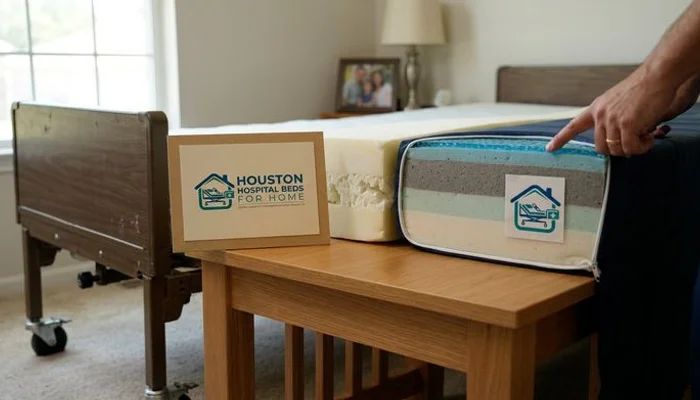
These mattresses tackle a specific problem: heat accumulation. We combine a high-density foam base with a top layer of cooling gel or gel-infused foam.
This technology works by increasing thermal conductivity to draw heat away from the body.
Pros:
- Temperature regulation: It helps keep skin dry, which reduces bedsore risk.
- Pressure redistribution: The gel layer displaces weight more effectively than foam alone.
- Shear reduction: The smooth top layer reduces friction on sensitive skin.
Cons:
- Weight: Gel layers add significant weight to the mattress.
- Cost: These models typically cost 30-50% more than standard foam.
Best for: Patients living in warm climates like Houston or those who naturally sleep hot.
Houston summers make temperature regulation more relevant than in cooler climates. Gel mattresses can make a noticeable comfort difference for patients in warm homes.
Memory Foam Mattress
Memory foam, or viscoelastic foam, is famous for its ability to contour to the body. We find it offers superior comfort for patients dealing with joint pain.
The material responds to body heat to mold around pressure points.
Pros:
- Pain management: Excellent for arthritis or chronic body aches.
- Motion isolation: Movements do not ripple across the bed.
- Comfort: Provides that distinct “cradling” sensation.
Cons:
- Movement restriction: The “sinking” feeling makes it hard for weak patients to turn over.
- Heat trap: Traditional memory foam retains more body heat than other types.
Best for: Hospice care or patients where maximum comfort is the priority over mobility.
Caution: We advise against memory foam for patients with limited strength. The foam “holds” their shape, which creates resistance when they try to scoot or roll.
Innerspring Mattress
This option uses metal coils similar to a traditional home mattress. It offers a familiar feel that some seniors prefer over foam.
We rarely recommend these for long-term medical use due to pressure issues.
Pros:
- Airflow: The open space between springs keeps the mattress cool.
- Responsiveness: The “bounce” can help patients sit up on the edge of the bed.
- Familiarity: It feels like a normal bed, which can be comforting.
Cons:
- Pressure points: Springs push back against the body, creating risk areas for bedsores.
- Noise: Older units can squeak when the bed frame adjusts.
- Mechanical wear: Bending metal springs repeatedly eventually leads to fatigue and breakage.
Best for: Patients who absolutely dislike the feel of foam and have healthy, mobile skin.
Alternating Pressure Mattress
These systems use an electric pump to inflate and deflate air cells in a programmed cycle. We consider this the “gold standard” for pressure injury prevention.
The cycle typically changes every 10 to 15 minutes to ensure no part of the body is under constant pressure.
Pros:
- Active therapy: It treats and prevents pressure ulcers (Stages 1-4).
- Adjustability: You can soften or firm the surface with a dial.
- Reduced labor: Caregivers do not need to manually turn the patient as often.
Cons:
- Noise: The pump emits a low hum that can disturb light sleepers.
- Maintenance: Air cells can puncture, and pumps require electricity.
- Height: These mattresses are often thicker, raising the overall bed height.
Best for: Completely immobile patients or those with existing wounds.
Read our complete alternating pressure mattress guide for detailed information.
How to Choose: Step-by-Step
Step 1: Assess Mobility
- Patient moves freely: We suggest Standard or High-Density foam.
- Patient needs help turning: We recommend High-Density foam for the firm support leverage.
- Patient cannot move: You must look at Alternating Pressure systems.
Step 2: Assess Skin Risk
- Healthy skin: Any mattress type is acceptable.
- Thin or fragile skin: Gel-foam or Alternating Pressure is necessary to reduce shear.
- Existing bedsores: Medical guidelines typically require Alternating Pressure therapy.
Step 3: Consider Comfort Preferences
- Likes a firm surface: High-Density foam or Innerspring.
- Likes a soft feel: Memory foam.
- Sleeps hot: Gel-foam hybrid.
- Indifferent: High-Density foam is the safest, most versatile bet.
Step 4: Match to Weight
- Under 250 lbs: Standard or High-Density foam works well.
- 250-350 lbs: High-Density foam is required to prevent bottoming out.
- Over 350 lbs: You need Bariatric-rated foam or a heavy-duty air system.
Step 5: Consider Budget
- Most affordable: Standard foam (usually included with the bed rental).
- Mid-range: High-Density or Gel-foam ($40-$100/mo extra).
- Premium: Alternating Pressure ($75-$150/mo extra).

Mattress Care Tips
Rotate regularly. We suggest swapping the head and foot ends once a month. This simple step prevents permanent body impressions from forming in the foam.
Use proper sheets. Standard Twin sheets are 75 inches long, but hospital mattresses are 80 inches long. You need “Twin XL” sheets to prevent the corners from snapping off when the bed raises.
Protect with waterproof covers. Do not remove the zippered cover that comes with the mattress. It is designed to be wiped down with mild cleaners and protects the inner core from spills.
Perform the “Hand Check.” Place your hand under the mattress while the patient is lying on it. If you can feel their bony prominences (like hips or shoulders) pressing down through the foam to your hand, the mattress has failed and needs immediate replacement.
We Help You Choose
Mattress selection is a core part of our setup process. We ask specific questions about your loved one’s mobility and skin health to match them with the correct surface.
Our team ensures the mattress fits the frame perfectly to avoid safety gaps.
Browse all options on our mattresses and accessories page or contact us for a free quote. Call (713) 555-0123 — we deliver across Greater Houston with same-day setup available.
Need a Hospital Bed in Houston?
Get a free, no-obligation quote with transparent pricing and same-day delivery options.